
Quick answer: The first 8 weeks with a new puppy cover six core areas: home setup, toilet and crate training, socialisation between 8 and 16 weeks, vaccination and worming, a sensible feeding routine, and a first groom after the second vaccination. Each area has a small set of reliable UK sources (RSPCA, Dogs Trust, PDSA, your vet) and a few common mistakes that are easy to avoid. The single biggest predictor of a calm adult dog is the socialisation you do in the first 16 weeks.
Why the first 8 weeks matter
Most new owners focus on toilet training and feeding, and skip the socialisation window. The data is clear: a puppy who is gently exposed to 100 different people, 30 different surfaces, and 20 different sounds between 8 and 16 weeks is dramatically less likely to grow into a fear-aggressive or noise-phobic adult dog. The window is narrow. It does not return.
The rest of this guide covers the six areas every new owner needs to handle in the first 8 weeks. Each section points to a more detailed spoke:
- Home setup and the first 72 hours: Bringing a puppy home UK
- Toilet training, crate training, and recall: Puppy training UK
- Vaccinations, worming, and the first vet visit: Puppy health UK
- Feeding routine and food choices: Puppy feeding UK
- The first groom: Puppy grooming UK
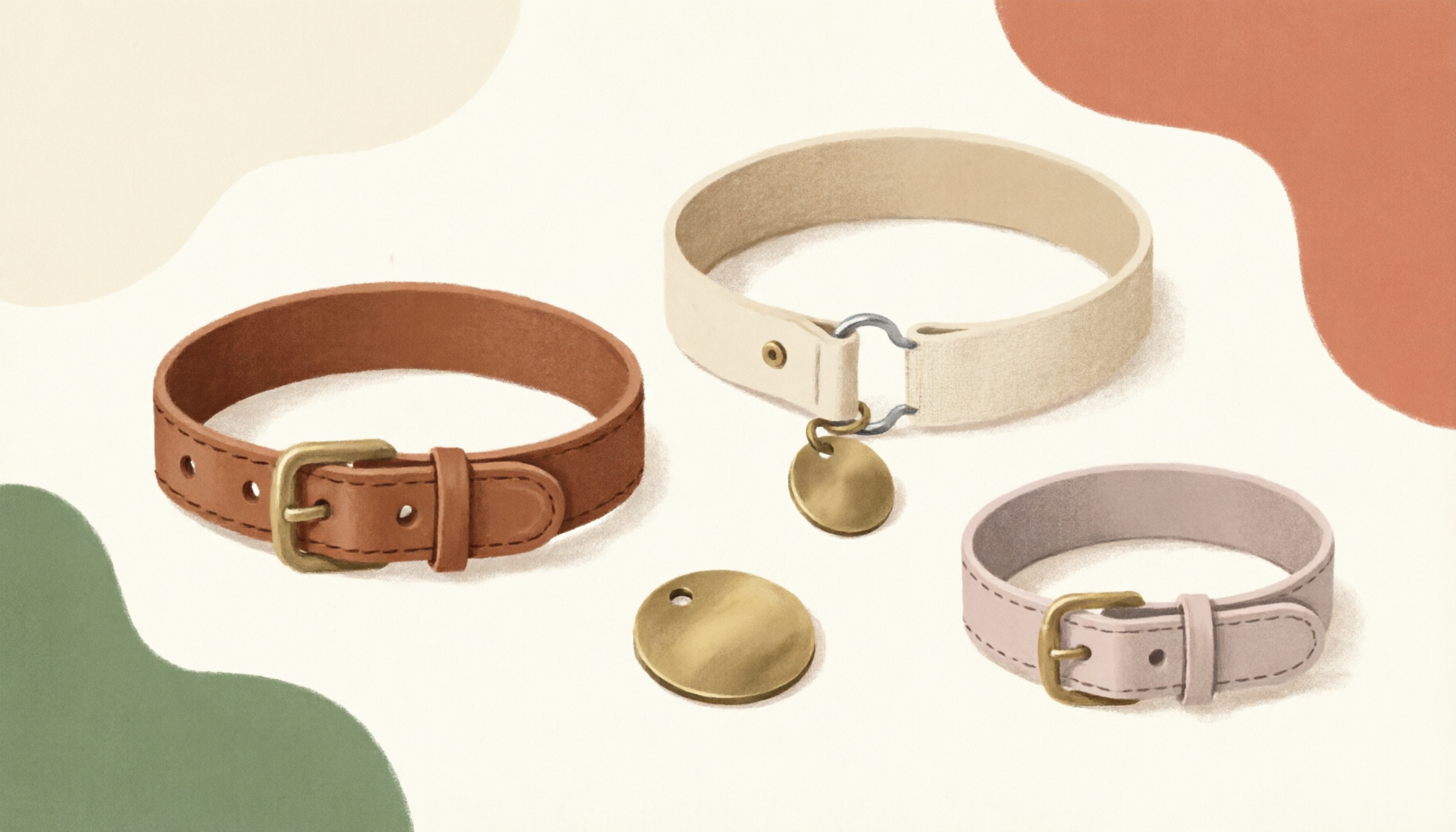
- Picking a collar and ID tag: our collars guide and collars/puppy
Home setup: the shopping list
A puppy needs a short list of essentials before they arrive.
- Bed: a washable, snug bed. Viscose or fleece cover. Avoid raised beds for the first 8 weeks (puppies fall).
- Crate: wire or fabric, sized so the puppy can stand, turn, and lie down. A divider panel for growth.
- Bowls: stainless steel or ceramic (plastic harbours bacteria in scratched surfaces). A slow feeder for fast eaters.
- Collar and lead: a flat, adjustable collar with a quick-release buckle. A 1.2 to 1.5 metre lead. Do NOT use a retractable lead for puppies.
- ID tag: UK law requires your name and address on the tag (or the dog microchipped, which is the recommended minimum).
- Food: the breeder's or rescue's existing brand for the first 2 weeks, then a gradual transition.
- Treats: small, soft, high-value. Training treats.
- Chew toys: a mix of soft and hard. Avoid rawhide (choking risk) and very hard plastic (tooth risk).
- Poo bags: 200 to start.
- Puppy pads: useful for the first 2 weeks while you learn the puppy's toilet schedule, then phase out.
Our new puppy gifts starter guide has a more detailed list with product suggestions.
The first 72 hours
The first 3 days set the tone. Plan to be home for at least the first week.
- Day 0 (collection day): short car ride, single room, water available, soft food. Let the puppy explore one room at a time. The first night is the hardest.
- Day 1 to 2: establish the toilet spot (always the same outside door). Take the puppy out every 1 to 2 hours, after meals, after naps, and after play. Praise and treat on success.
- Day 3 to 7: introduce the daily routine: same wake time, same feed time, same walk time. Puppies thrive on predictability.
The first night is the most Googled puppy question in the UK. See our first 72 hours guide for the full night routine.
Toilet training, crate training, recall
Three training priorities, in order.
Toilet training (weeks 1 to 4): take the puppy out every 1 to 2 hours. Use a consistent cue word ("busy", "toilet", "potty"). Reward on success with a treat and calm praise. Do not punish accidents indoors; just clean with an enzymatic cleaner and watch for the next time. Most puppies are reliably clean by 4 to 6 months.
Crate training (weeks 2 to 6): introduce the crate as a positive space (treats, chews, nap time). Never use the crate as punishment. A puppy under 6 months should not be crated for more than 3 to 4 hours at a stretch. The crate is the most useful training tool for toilet training: a puppy will not soil where they sleep.
Recall (weeks 4 to 12): start in a quiet room with high-value treats. Use the puppy's name + a cue word ("come"). Reward on the first step toward you. Build to a long line in the garden. Never call the puppy to punish: recall must always be a positive event.
The full training framework is in puppy training UK.
Vaccinations, worming, and the first vet visit
The UK puppy vaccination schedule is:
- First vaccination: 8 weeks (Nobivac DHP + L4 + sometimes kennel cough).
- Second vaccination: 10 to 12 weeks.
- Full protection: 1 to 2 weeks after the second vaccination.
- Annual boosters: yearly.
Until full protection, puppies should not walk on public ground (parks, pavements) where unvaccinated dogs may have been. Carry them or use a garden. Socialisation is still important in this window: invite vaccinated, friendly dogs to your home or garden.
Worming: every 2 weeks until 12 weeks, then monthly until 6 months, then every 3 months. Your vet will give a worming plan at the first visit.
First vet visit: book within the first 3 days. The vet checks the puppy, sets up the vaccination and worming schedule, and answers your questions. The cost is usually £30 to £50 for the consultation.
The full vaccination and health schedule is in puppy health UK.
Feeding routine
A practical first-month feeding routine:
- 8 to 12 weeks: 4 meals a day, evenly spaced.
- 3 to 6 months: 3 meals a day.
- 6 months +: 2 meals a day.
Puppy-specific food is higher in protein and calcium than adult food. The brand does not matter as much as the routine. Switch brands gradually over 7 to 10 days to avoid a tummy upset. Fresh water always available.
The full feeding guide (including raw vs kibble, treats, and the "what about supplements" question) is in puppy feeding UK.
The first groom
The first groom is 1 to 2 weeks after the second vaccination, around 11 to 14 weeks of age. A good groomer will offer a "happy visit" first: a short 20 to 30 minute session focused on confidence rather than styling.
The full guide (what to ask, what to expect, and how to choose a puppy-friendly groomer) is in puppy grooming UK.
Socialisation: the 8 to 16 week window
The single most important thing a new owner can do in the first 16 weeks. The window does not return. After 16 weeks, the puppy's brain is more set in its ways; new experiences take longer to be accepted.
A practical socialisation protocol:
- People: 100 different people across men, women, children, babies, people in hats, people in uniforms, people with beards. Each encounter is a quick "say hello, give a treat, move on".
- Surfaces: grass, concrete, gravel, sand, wood, metal grates, slippery floors. Each new surface builds confidence.
- Sounds: traffic, vacuum, hairdryer, fireworks recording (low volume at first), thunder, doorbell.
- Animals: vaccinated, friendly adult dogs. Other species (cats, rabbits) where safe.
- Transport: car, bus, train (post-vaccination).
For the full framework including the "100 people in 100 days" approach, see puppy training UK.
The honest truth about the first year
The first 8 weeks are the hardest. You will be sleep-deprived. You will clean up puddles. You will wonder why you did this. Around month 4 to 6, the puppy settles. Around month 8 to 12, you have an adult dog.
The work you do in the first 16 weeks pays back for the next 12 to 16 years. A well-socialised, well-trained, well-fed puppy is a calm, confident adult dog. A skipped-window puppy is a behaviour-case adult dog.
It is worth the work.
Common new-owner mistakes (and how to avoid them)
Six mistakes that UK owners make in the first 8 weeks. Each is fixable with a small adjustment.
- Too much too soon. Carrying the puppy to the pub, to a busy market, to a noisy family dinner, in the first week. The puppy is adjusting. Quiet days at home are the right first week.
- Skipping the socialisation window. Waiting until vaccinations are complete before introducing the puppy to the world. The window is 8 to 16 weeks. By the time vaccinations are done, the window is half-closed.
- Free-feeding. Leaving food down all day. Free-fed puppies are harder to toilet train, harder to monitor appetite, and more likely to be overweight as adults. Two to four meals a day, on a schedule.
- Punishing accidents. Rubbing the puppy's nose in it, shouting, putting them outside. Punishment does not speed up toilet training; it teaches the puppy to hide the evidence. Reward on success, clean up quietly.
- Skipping the vet visit. Waiting for the second vaccination before seeing the vet. The first vet visit is the right place to ask the questions that have built up over the first week.
- Not budgeting. Puppies are expensive. The first-year cost for a medium dog in the UK in 2026 is £1,500 to £2,500 (food, vet, vaccinations, neutering, training, insurance, bed, collar, lead, toys, grooming). Plan for it.
FAQ
Frequently Asked Questions
What do I need to buy before bringing a puppy home UK?
The essentials are: a washable bed, a crate with a divider, stainless steel or ceramic bowls, a flat-buckle collar and lead, an ID tag with your name and address, a supply of the breeder's existing food, training treats, chew toys, and poo bags. See our [new puppy gifts starter guide](/blog/new-puppy-gifts-starter-guide) for a fuller list.
When can a puppy go outside UK?
After the second vaccination (around 11 to 12 weeks) plus 1 to 2 weeks for full protection. Until then, carry the puppy in public or use a private garden. Invite vaccinated, friendly dogs to your home or garden for socialisation in the meantime.
How often should I feed a puppy?
4 meals a day from 8 to 12 weeks, 3 meals a day from 3 to 6 months, 2 meals a day from 6 months onwards. Use a puppy-specific food and switch brands gradually over 7 to 10 days.
When should a puppy have its first groom UK?
1 to 2 weeks after the second vaccination, around 11 to 14 weeks. Book a short 20 to 30 minute happy visit first to build confidence before a full groom. See our [puppy grooming UK guide](/blog/puppy-care-grooming-uk) for the full routine.
Picking a first collar? See our collars guide for material, fit, and ID tag UK law. Need a bed? See our beds guide for the first-bed essentials.
Bringing a puppy home UK Puppy training UK Puppy health UK Puppy feeding UK Puppy grooming UK Collars guide Beds guide Complete UK dog grooming guide