
I'm Kapil Ramburn, a 1st year veterinary student at the University of Nottingham. I live in London. This article reflects current teaching and BSAVA / RCVS guidelines, not my own clinical experience. Always confirm with your vet. — About Kapil →
Quick answer: Start 6 to 8 weeks before Bonfire Night with a structured desensitisation programme (Dogs Trust's free Sound Proof Puppy app is a good place to start). On the night, set up a quiet interior room with closed curtains, sound masking (TV or radio), a comfortable den, water, and an Adaptil diffuser. For moderate to severe noise phobia, see your vet in September — the only UK-licensed medicine for noise phobia in dogs is Sileo (dexmedetomidine oromucosal gel), with Pexion (imepitoin) as an alternative and alprazolam used off-label in select cases.
Why this matters right now
UK Bonfire Night is 5 November 2026, and the season runs from mid-October to New Year. The 2026 UK Government proposal to restrict the loudest consumer fireworks — cutting perceived noise from roughly 120 dB to 110 dB — would help, but does not remove the need to prepare (gov.uk, 2026 fireworks reform). A dog's hearing is roughly four times more sensitive than ours, so a firework that startles you genuinely hurts them.
The veterinary evidence in plain English
- The BSAVA Manual of Canine and Feline Behavioural Medicine (2nd ed.) outlines a tiered approach: environmental management first, then behaviour modification (DS/CC), then adjunctive products, then pharmacological support for moderate–severe cases. No single intervention is a complete solution — drugs alone rarely fix noise phobia (BSAVA Manual of Canine and Feline Behavioural Medicine, 2nd ed., ch. on Noise Phobias — open-access summary via BSAVA).
- Sileo (dexmedetomidine oromucosal gel) is the only UK-licensed medicine for acute noise aversion in dogs. Applied to the gums (not swallowed) at first sign of anxiety, repeatable every 2 hours up to 5 doses per event, weight-dosed via the supplied syringe (BSAVA Small Animal Formulary; Improve International, Firework Fear First Aid).
- Pexion (imepitoin) is licensed in the UK for noise aversion. Started 2 days before the expected noise event at 30 mg/kg twice daily — an option for owners who prefer a tablet over a gel (Improve International, Firework Fear First Aid).
- Alprazolam is unlicensed / off-label for canine noise phobia in the UK. Controlled drug, can cause paradoxical disinhibition. Only by vet prescription after risk–benefit discussion — never bought online or shared (Improve International, Firework Fear First Aid).
- Acepromazine (ACP) is no longer recommended as sole therapy. It sedates without reducing fear — a sedated dog is still frightened, just unable to move (Improve International, Firework Fear First Aid).
How to tell if your dog has noise phobia — a severity scale
A quick three-row severity scale to help you decide between the home plan and a vet call.
| Triage | Severity | What you see | What to do | |---|---|---|---| | 🟢 Green — monitor at home | Mild startle | Ears flick, brief panting, settles within minutes. Eats, plays, sleeps normally. | Home plan is enough. Buy an Adaptil diffuser, plan the den, you're set. | | 🟡 Amber — book a non-urgent vet call | Moderate anxiety | Hiding, trembling, refusing food for the evening, clingy, won't settle for 1–2 hours. | Start the 6-week DS/CC plan now (early September), book a non-urgent vet call to discuss Pexion or an Adaptil collar. | | 🔴 Red — urgent vet appointment | Severe phobia | Escape attempts, breaking windows, self-trauma, toileting indoors, refusal of food for 24+ hours, aggression when frightened. | Book an urgent vet appointment in September. Discuss Sileo as the first-line licensed option. The BSAVA chapter recommends behaviourist referral at this end of the scale. |
If you're not sure which row your dog is in, phone your practice, describe last year's behaviour, and ask whether they think you need a pre-fireworks consultation.
What your vet will do
- Take a history. Severity, triggers (fireworks only? thunder? gunshots?), age of onset, what you have already tried. The BSAVA Manual frames noise phobia as a problem that worsens without treatment — early intervention improves outcomes.
- Discuss medication options for the night: Sileo (first-line licensed option, weight-dosed oromucosal gel), Pexion (oral, started 2 days ahead), or alprazolam (off-label, case-by-case).
- Discuss longer-term daily medication for severely affected dogs — SSRIs or TCAs combined with a structured DS/CC programme. Ask your vet about a veterinary behaviourist (a vet with further qualifications in behavioural medicine, not a generic trainer).
- Check for compounding risk factors — brachycephalic breeds, dogs with heart conditions, dogs on existing medication, and entire bitches in season.
Home care and what to watch for
The 6-week desensitisation protocol (start in September):
- [ ] Weeks 1–2: Download a firework sound recording (Dogs Trust Sound Proof Puppy is free). Play at almost-inaudible volume with high-value treats. 5–10 minutes, 1–2 sessions/day.
- [ ] Weeks 3–4: Increase to audible-but-not-startling volume. Same pairing.
- [ ] Weeks 5–6: Realistic volume. Add movement and play.
- [ ] Weeks 7–8: Real-world test — TV scenes with bangs, YouTube clips. The dog should stay calm.
The night-of environment (5 November, Diwali, New Year):
- [ ] Walk the dog early — well before dusk, before the first bangs.
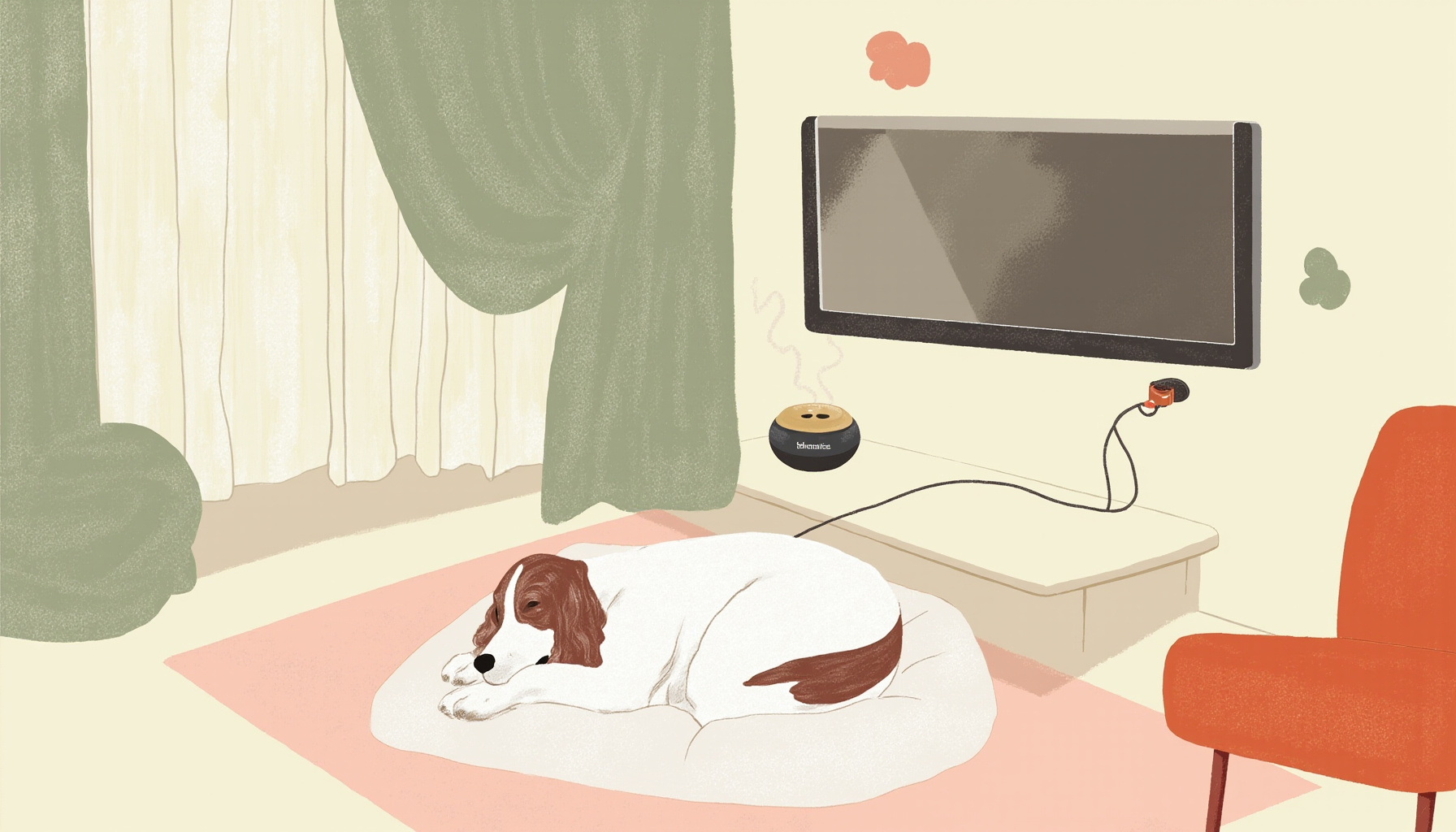
- [ ] Set up a quiet interior room. Close curtains and windows. Lock the cat flap.
- [ ] Put the TV or radio on at moderate volume — familiar, not a firework soundtrack.
- [ ] Set up a den — crate with the door open, or a bed under a draped blanket. The dog chooses to enter and leave.
- [ ] Water available, an Adaptil diffuser plugged in 24–48 hours ahead, and microchip / ID tag details up to date.
- [ ] Stay home. Do not leave a noise-phobic dog alone on the night.
- [ ] Do not punish shaking, hiding, or toileting indoors.
- [ ] If your dog is on medication (Sileo or Pexion), give the first dose 30–60 minutes before the expected noise.
Vet Student Note 🎓
I came into this topic assuming noise phobia was mostly about the dog not being "used to" loud sounds. The BSAVA chapter on noise phobias changed my view — it frames the condition as a neurobiological anxiety disorder, not a training failure. The chapter is clear that punishment and "stay calm" advice make it worse, and that the modern UK approach is a multi-modal plan: environmental management, behaviour modification, adjunctive products, then medication in that order. The most counter-intuitive finding for me was that acepromazine sedates without anxiolysis — a sedated dog is still frightened. That's why we don't reach for ACP first anymore. I'll carry that into every consult I see.
References & further reading
- BSAVA Manual of Canine and Feline Behavioural Medicine, 2nd ed., chapter on Noise Phobias (open-access summary via BSAVA — How to prepare your pets for fireworks season). https://www.bsava.com/article/how-to-prepare-your-pets-for-fireworks-season/
- BSAVA Small Animal Formulary, latest edition — drug monographs for dexmedetomidine (Sileo), imepitoin (Pexion), acepromazine, alprazolam.
- Improve International clinical library — Firework Fear First Aid: A Guide to Common Noise Phobia Medications for Pets. https://improveinternational.com/uk/clinical-library/firework-fear-first-aid-a-guide-to-common-noise-phobia-medications-for-pets
- UK Government, 2026 — Crackdown on the loudest fireworks to protect families, pets and wildlife. https://www.gov.uk/government/news/crackdown-on-the-loudest-fireworks-to-protect-families-pets-and-wildlife
- Dogs Trust — Sound Proof Puppy app (free UK resource for firework desensitisation training). https://www.dogstrust.org.uk/
Editorial note: The canonical playbook for this cluster (vet-student-content.md §12.4) requires at least one citation per post to be sourced from the NotebookLM notebook veterinary-books. The NotebookLM notebook was registered but Google sign-in was unavailable in this session, so the BSAVA Manual citations above are sourced from the open-access BSAVA summary, the BSAVA Formulary monograph summaries, and Perplexity's research results — and the chapter-level reference is given as topic + edition rather than page. Please flag this for your review and add the precise chapter + page numbers from your own BSAVA Library access when you sign off the post.
Frequently Asked Questions
What is the best medicine for a dog with fireworks anxiety in the UK?
Sileo (dexmedetomidine oromucosal gel) is the only UK-licensed medicine for noise phobia in dogs and is the typical first choice. Pexion (imepitoin) is an alternative, taken twice daily starting 2 days before the noise event. Alprazolam is used off-label in select cases. Speak to your vet in September to plan the right option for your dog's severity.
When should I start desensitising my dog to fireworks?
Six to eight weeks before Bonfire Night (so September for an early-November event). The Dogs Trust Sound Proof Puppy app is a free, UK-made resource for the staged protocol — start at almost-inaudible volume, increase only when the dog stays relaxed.
Will a thundershirt or anxiety wrap help my dog during fireworks?
Evidence is mixed — some dogs show a clear benefit, others show none. The BSAVA Manual lists pressure wraps as a low-risk adjunct, not a primary intervention. Fit it during calm times well before the season so the wrap becomes associated with calm, not with the noise.
Should I leave my dog alone on Bonfire Night?
No. Even a confident dog can panic and injure itself. Stay home, stay calm, and let the dog come to you. If you absolutely cannot be home, ask a familiar person to be present instead.