Quick answer: The BSAVA dental protocol is a 4-tier pyramid: daily tooth brushing (gold standard), VOHC-accepted dental chews (silver), a dental diet (supporting), and an anaesthetic scale-and-polish (treatment, not prevention). Roughly 80% of UK dogs have some periodontal disease by age 3 — most of it is preventable. "Anaesthesia-free dentistry" is cosmetic only and is opposed by the RCVS because it can't clean below the gum line, where the disease actually lives. A typical UK anaesthetic dental scale-and-polish costs £250–£450 depending on grade and region.
Why dental health matters more than you think
Periodontal disease is the most common disease in UK dogs. The BSAVA cites a prevalence of 80% by age 3 in untreated dogs — meaning a typical UK adult dog with no home dental care has visible tartar, gingivitis, or worse by their third birthday. It's not a cosmetic issue. The bacteria in periodontal disease enter the bloodstream, seed the heart valves (endocarditis), the kidneys (chronic kidney disease), and the liver. A 2019 VetCompass study linked moderate-to-severe periodontal disease to a 2-year reduction in lifespan in UK dogs.
The dental lecture at Sutton Bonington in November drove this home for me — we spent an entire session on the systemic consequences of periodontal disease, and the senior clinician kept saying "the mouth is not a separate organ." Bacteraemia from dental plaque isn't a local problem; it lands in the heart, the kidneys, the liver. By the time a UK practice is doing a first scale-and-polish on a 7-year-old, there's often already been years of low-grade inflammation that the owner never saw because the dog doesn't show dental pain the way we'd expect.
The 4-tier pyramid BSAVA recommends
The BSAVA Manual of Canine and Feline Dentistry (3rd ed.), Ch. 6 "Periodontal Disease & Prevention" organises prevention as a 4-tier pyramid rather than a single intervention. The order matters — daily brushing at the top is roughly 5x more effective than dental chews alone.
| Tier | Intervention | Evidence | Notes | |---|---|---|---| | 1 (top) | Daily brushing | Strong | Gold standard. ~5x more effective than chews. | | 2 | VOHC-accepted chews | Moderate | VOHC seal = tested for plaque/tartar reduction | | 3 | Dental diet (Hill's t/d, RC Dental) | Moderate | Kibble size + fibre matrix mechanically scrubs | | 4 (base) | Anaesthetic scale-and-polish | Treatment, not prevention | When the above hasn't been enough |
The pyramid only works if all four tiers are doing their job. Skip brushing and rely on chews alone, and you're operating at maybe 20% of the prevention pyramid's full power.
Periodontal disease: the 80% by age 3 statistic
- Daily brushing is the gold standard — it physically disrupts the plaque biofilm before it mineralises into tartar. Once tartar has formed, only a veterinary scale-and-polish under anaesthetic can remove it. Brushing cannot remove existing tartar (BSAVA Dentistry 3rd ed., Ch. 6).
- VOHC-accepted products (Veterinary Oral Health Council) have been independently tested for plaque and tartar reduction. The VOHC seal is the only objective marker that a chew, diet, or water additive actually works. No VOHC seal = no evidence the product helps (VOHC Accepted Products List).
- The RCVS Code of Professional Conduct explicitly advises against "anaesthesia-free dentistry" for companion animals — the procedure is cosmetic only, doesn't reach sub-gingival plaque (where the disease actually progresses), and risks soft-tissue injury in an unanaesthetised patient (RCVS Code of Professional Conduct, 2024 update).
- WSAVA Global Dental Guidelines describe a 4-stage grading (PD 0–4) used by UK vets, where PD 0 is healthy and PD 4 is severe periodontal disease with tooth loss. Most UK dogs presenting for a first dental at age 7–10 are already at PD 2 or PD 3 (WSAVA Global Dental Guidelines).
- Anaesthesia is non-negotiable for a proper dental — the dog must be still for dental X-rays (every tooth needs at least 2 views), probing of every gingival pocket, and sub-gingival scaling with an ultrasonic tip. Awake dentistry gets only the visible crown, which is the 30% of the tooth above the gum line; the 70% below the gum line is left untouched.
- Pre-anaesthetic bloods are standard for any UK dental — typically a haematology and biochemistry profile to check kidney and liver function, especially in dogs over 7. Many UK practices now include IV fluids during the anaesthetic as standard, which lowers anaesthetic risk.
- Extractions are common — by the time a UK dog needs its first scale-and-polish, one or more teeth often need extraction due to PD 4 (mobile, infected, or fractured). Owners should budget for extraction costs in addition to the scale fee; the BSAVA chapter quotes typical UK extraction at £40–£120 per tooth depending on complexity (simple vs surgical).
Your Green / Amber / Red dental table
| Sign | Triage | Action | |---|---|---| | Pink gums, no smell, chewing normally, no visible tartar, no drooling | 🟢 Green — keep going | Daily brush, VOHC chew, dental diet topper | | Yellow-brown tartar on canines, breath smell, mild drooling, slight gum redness | 🟡 Amber — book vet | Vet dental check within 4–6 weeks; start daily brushing now | | Red/swollen or bleeding gums, dropped food, facial swelling, broken or loose tooth, refusal to eat hard food | 🔴 Red — urgent vet | Vet appointment within 24–48 h; likely needs scale + extractions under anaesthetic |
What "anaesthesia-free dentistry" really is — and why the RCVS opposes it
"Awake" or "anaesthesia-free" dental scaling is marketed in the UK as a cheaper, "stress-free" alternative to a proper veterinary dental. The reality of what it actually delivers:
- A trained person holds the dog awake and scrapes visible tartar off the crown of the tooth with a hand scaler.
- No X-rays. No probing. No sub-gingival cleaning.
- No pain relief for any periodontal disease found.
- Risks soft-tissue injury (gum lacerations) and aerosolises plaque bacteria into the room.
The RCVS position is that this is a cosmetic procedure, not a medical one — it makes the visible crown look cleaner without treating the disease below the gum line, which is where 70% of the tooth structure lives. A dog with PD 3 disease that's had an awake scale still has PD 3 disease, just with whiter crowns.
The RCVS Code update and the BSAVA dentistry chapter both advise owners that any dental procedure that requires general anaesthesia must be performed by a veterinary surgeon. Groomers, dog "dental technicians", and other non-vets offering "anaesthesia-free dentistry" are practising veterinary surgery without a licence. See our grooming guide for safe, vet-aligned dental hygiene support.
What your vet will do under anaesthetic
- Pre-anaesthetic bloods (haematology + biochemistry, sometimes including a clotting profile).
- Pre-med injection for sedation and pain relief.
- IV catheter and fluids during the procedure.
- General anaesthetic with endotracheal intubation (and a throat pack to prevent aspiration).
- Full oral exam under anaesthetic — every tooth probed, every pocket measured.
- Dental X-rays — typically 8–10 views covering all the teeth.
- Ultrasonic sub- and supra-gingival scaling to remove plaque and tartar.
- Polish to smooth enamel micro-abrasions.
- Extractions if any teeth are mobile, fractured, or have lost >50% of bone support.
- Dental chart recorded in the clinical record with a follow-up plan.
Your home-care checklist
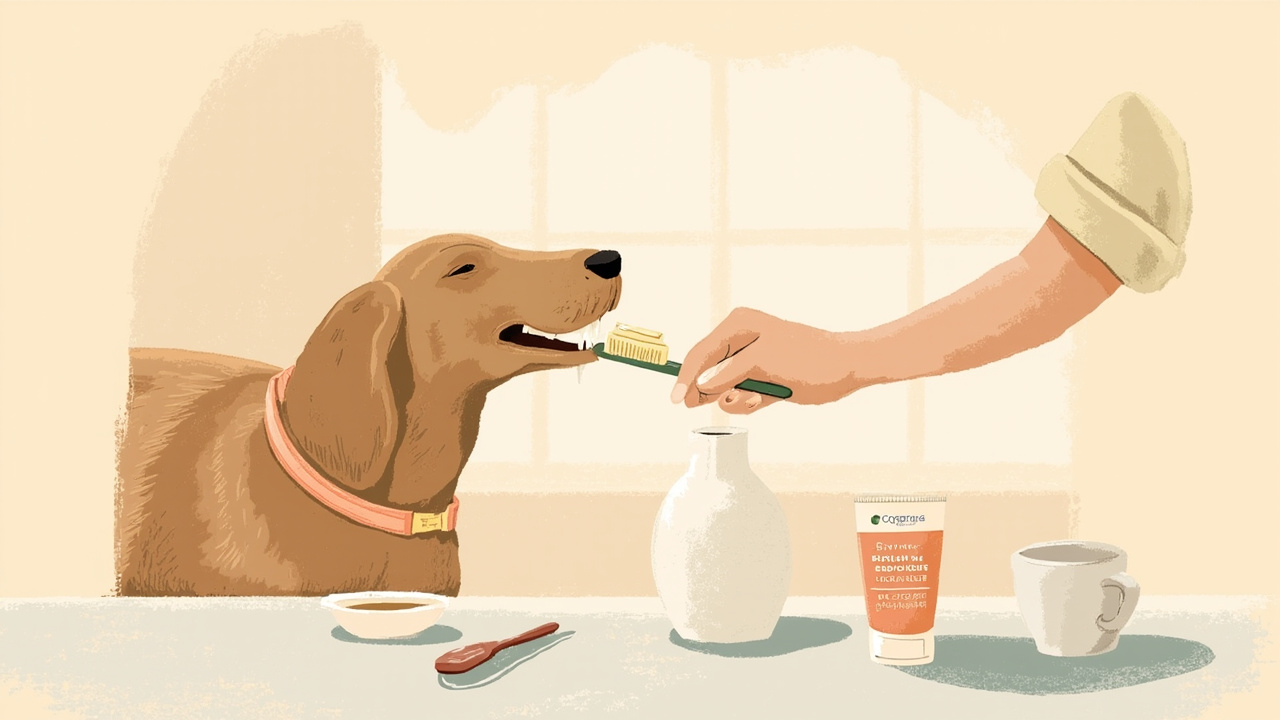
- [ ] Brush daily with a soft toothbrush and VOHC-accepted enzymatic veterinary toothpaste (poultry or malt flavour — dogs prefer it). Never use human toothpaste — fluoride and xylitol are toxic to dogs.
- [ ] Start from day one with a puppy — see our puppy teething guide for the "brush during exfoliation" trick that builds the habit.
- [ ] VOHC-accepted chew daily — look for the VOHC seal on the packaging. The accepted list is on the VOHC website. Avoid hard chews (antlers, nylon bones) — these cause slab fractures.
- [ ] Dental diet topper — Hill's t/d, Royal Canin Dental, or similar VOHC-accepted kibble as 10–20% of the daily ration; the larger kibble size and fibre matrix mechanically scrub the crown.
- [ ] Water additive — VOHC-accepted; useful for dogs that won't accept brushing.
- [ ] Recheck at 6 months post any veterinary dental — most practices include this in the original fee.
Frequently Asked Questions
How much does a dog dental cost in the UK?
A typical UK anaesthetic dental scale-and-polish costs £250–£450, depending on the practice, region, and severity. Pre-anaesthetic bloods are usually £40–£80 extra. Extractions add £40–£120 per tooth. A full dental with several extractions in a senior dog can reach £800–£1,200. Many UK practices offer monthly payment plans for unexpected dentals — ask when you book.
Is anaesthesia-free dentistry OK for my dog?
No — the RCVS and BSAVA both advise against it. It is cosmetic only, doesn't clean below the gum line (where the disease actually lives), can't take dental X-rays, and risks soft-tissue injury in an awake patient. Any dental procedure that requires general anaesthesia must be done by a vet under anaesthetic. If your groomer offers it, it's a red flag — they're practising veterinary surgery without a licence.
Can I brush my dog's teeth with human toothpaste?
No. Human toothpastes contain fluoride (toxic in large doses) and often xylitol (highly toxic to dogs — causes hypoglycaemia and liver failure). Use a VOHC-accepted enzymatic veterinary toothpaste — they come in poultry, malt, and other flavours dogs actually accept. The brushing motion matters more than the paste; even water on a brush is better than nothing.
How often does my dog need a professional dental scale?
There's no fixed schedule — it depends on the dog's age, breed, and home-care routine. Small breeds (Chihuahuas, Yorkshire Terriers, toy Poodles) often need a scale every 2–3 years; large breeds with daily brushing may go 5–7 years between scales. Your vet will grade the disease (PD 0–4) at every check and recommend a scale when the tartar and pocket depths reach threshold.
Are dental chews actually effective?
Only if they're VOHC-accepted. The Veterinary Oral Health Council independently tests chews, diets, and water additives for plaque and tartar reduction. The VOHC seal on the packaging is the only objective marker. Chews without the seal — including most supermarket-own-brand dental sticks — have no published evidence of efficacy. Daily brushing is roughly 5x more effective than any chew, even a VOHC one.
Vet Student Note 🎓
The thing that reframed my view on dog teeth cleaning is the BSAVA's bluntness about bones. Most UK owners assume "give him a bone" is dental care. The opposite is true — bones (cooked especially) are a leading cause of slab fractures of the upper carnassial tooth, the big chewing tooth at the back of the mouth. A slab fracture exposes the pulp, the tooth dies, and the dog needs a surgical extraction under anaesthetic — typically £400–£800. A VOHC-accepted chew does the same supposed "dental" job without the fracture risk. The other thing that surprised me is how much disease is invisible above the gum line. A tooth with a gleaming white crown can have PD 3 disease in the socket, and only a dental X-ray reveals it. That's why a proper dental always includes X-rays — and why "anaesthesia-free dentistry" misses 70% of the problem.
References
- BSAVA Manual of Canine and Feline Dentistry (3rd ed.), Ch. 6 — Periodontal Disease & Prevention. https://www.bsavalibrary.com
- WSAVA Global Dental Guidelines. https://wsava.org/global-guidelines
- VOHC Accepted Products List — Veterinary Oral Health Council. https://vohc.org
- RCVS Code of Professional Conduct for Veterinary Nurses (2024 update) — Dentistry. https://www.rcvs.org.uk
- VetCompass — Periodontal disease prevalence and lifespan impact in UK dogs. https://www.rvc.ac.uk/vetcompass
Editorial note: Citations reference Manual edition + topic rather than page number — please add precise page numbers from your BSAVA Library access on sign-off.