
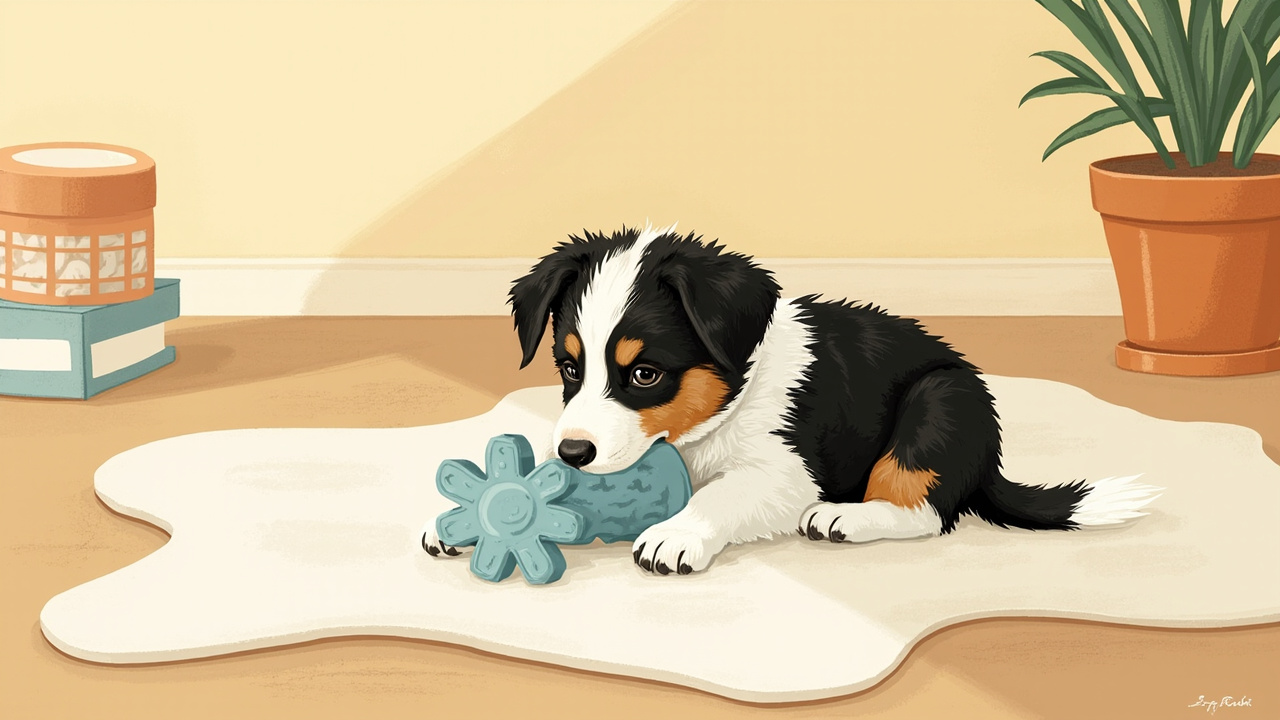
Quick answer: Puppies go through four dental stages: deciduous eruption at 3–6 weeks, occlusion by 8 weeks, exfoliation (losing baby teeth) from 12–24 weeks, and full adult dentition by 6 months. The chewing, nipping, and bleeding gums are normal — but retained deciduous teeth at 6 months (especially canines) need veterinary extraction. Safe chews: frozen wet tea-towels, Kongs stuffed and frozen, soft rubber puppy toys. Avoid: antlers, hard nylon bones, ice cubes, and cooked bones — they fracture puppy teeth.
Why spring is puppy-teething season in the UK
The UK sees a spring puppy-adoption spike every March–June (Dogs Trust and RSPCA report a 30–40% rise in rehoming enquiries around this window), and teething questions flood into vet practices in lockstep. The reason this matters clinically: a puppy's deciduous teeth are much thinner and more fragile than an adult dog's, so the chews that are safe for an 18-month Labrador can fracture a 12-week puppy's tooth in a single bite. The BSAVA Manual of Canine and Feline Dentistry dedicates a full chapter to puppy dental development for this reason.
The question I expect to hear most in my first small-animal placement is "what can I give him to chew?" — and the BSAVA/WSAVA answer is more restrictive than most owners expect. Hard chews marketed as "dental" are a leading cause of slab fractures in puppies and adult dogs, and that's a surgery, not a fix.
The 4 dental stages BSAVA tracks
The BSAVA Manual of Canine and Feline Dentistry (3rd ed.), Ch. 1 "Puppy Dental Development" outlines four discrete stages. Owners usually only see the middle two — but the first two matter because they shape what the breeder should have done.
- Deciduous eruption (3–6 weeks) — 28 baby teeth come in. Breeders should be handling mouths, lifting lips, and touching teeth from this stage. Puppies that never have their mouths handled as neonates grow up head-shy and difficult to examine.
- Occlusion check at 8 weeks — the bite should be a scissor bite (upper incisors just overlap the lowers). Wry bite, overshot, or undershot bites are breed-specific concerns and should be flagged by the breeder and your vet.
- Exfoliation (12–24 weeks) — baby teeth roots resorb and the teeth fall out. Owners find tiny teeth on the floor or in food bowls. Adult teeth erupt through the same gum line so a puppy can have a baby canine and an adult canine in the same socket for several weeks. This is normal — but if a baby tooth is still firmly in place when the adult tooth has fully erupted (especially after 5 months), it is "retained" and needs extraction.
- Adult dentition at 6 months — 42 adult teeth. Any baby tooth still present at 6 months (especially canines) needs extraction under anaesthetic, ideally before 9 months, to prevent adult-tooth crowding and periodontal disease.
Why puppy teeth break more easily than you'd think
A puppy's deciduous tooth has thinner enamel, a larger pulp chamber, and shorter roots than an adult tooth. The BSAVA dentistry chapter summarises it as "structurally the same tooth, mechanically a different one." That's why a chew that just bounces off an adult carnassial tooth can slab-fracture a puppy's in one bite.
- Antlers, hard nylon bones, and ice cubes cause slab fractures of the upper carnassial tooth (the big chewing tooth at the back) — WSAVA explicitly lists these as inappropriate for puppies AND adult dogs (WSAVA Global Dental Guidelines).
- Cooked bones splinter and can puncture the gut. Raw bones from a butcher are safer but still carry bacterial and fracture risks; the BSAVA dentistry chapter recommends supervised chew sessions only and avoiding weight-bearing bones (femur, knuckle) entirely.
- Sticks are a UK-specific cause of mouth and oesophageal injuries — RCVS Knowledge has run seasonal alerts on stick injuries in spring and summer, when dogs are carrying and chewing them in long grass.
- Tooth fractures expose the pulp. Once that happens, the tooth dies. Dead teeth need either root canal or extraction; the BSAVA chapter considers extraction the standard of care for most fractured deciduous teeth.
Retained baby teeth: the chronic problem hiding in plain sight
- Puppies have 28 deciduous teeth; adult dogs have 42. The 14 extra adult teeth are molars — premolars and molars don't have deciduous predecessors, which is why they erupt directly without a "fall out" stage (BSAVA Manual of Canine and Feline Dentistry, 3rd ed., Ch. 1).
- Retained deciduous canines are the most common problem. Toy and small breeds (Chihuahuas, Yorkshire Terriers, Pomeranians, toy Poodles) are over-represented. The retained baby canine forces the adult canine to erupt rostrally (in front of) or lingually (behind) the baby tooth, causing crowding, plaque trap, and early periodontal disease. Extraction under anaesthetic is the standard treatment (BSAVA Dentistry 3rd ed., Ch. 1).
- WSAVA Global Dental Guidelines recommend tooth brushing from day one, even before the adult teeth erupt. The goal isn't to clean the baby teeth (they'll fall out) — it's to teach the puppy that mouth-handling is normal. By the time the adult teeth are in, brushing is a routine, not a battle.
- Nipping and biting during teething is normal puppy behaviour and not a sign of aggression. It's driven by gingival inflammation as the adult teeth erupt. Don't punish mouthing — redirect onto an approved chew, and stop play-biting sessions cleanly without drama.
- Bleeding gums are normal during exfoliation. A few drops of blood on a chew toy is fine. Persistent bleeding, a swollen face, or a broken tooth is not.
- Brush from day one — the single biggest predictor of a dog's dental health at age 5 is whether the owner is brushing daily at 6 months.
Your Green / Amber / Red chewing table
| Sign | Triage | Action | |---|---|---| | Soft rubber puppy chew, gentle mouth-play, tiny drop of blood on toy, mild gum redness | 🟢 Green — normal teething | Redirect onto approved chew; brush daily; supervised chew sessions | | Refusing hard kibble, drooling more than usual, pawing at mouth, persistent whimpering while eating | 🟡 Amber — book vet | Soft food / soaked kibble for 48 h; vet appointment within 1 week; check for retained baby teeth | | Broken or fractured tooth, facial swelling, persistent bleeding, retained baby canine at 6 months, puppy refusing to eat for >24 h | 🔴 Red — emergency vet | Same-day vet appointment; suspected fracture or abscess needs imaging and likely extraction under anaesthetic |
What's safe to chew (and what the BSAVA bans)
Safe chews for puppies (BSAVA + WSAVA aligned):
- Frozen wet tea-towel — twisted, tied in a knot, frozen flat. Cheap, replaceable, soothes inflamed gums.
- Kong puppy toy, stuffed and frozen — smear with xylitol-free peanut butter or wet food, freeze for 4 hours. The "licking out" action is the same soothing mechanism as a frozen teething ring for human babies.
- Soft rubber puppy-specific chews — brands labelled "puppy" or "soft" with some give when pressed with a thumbnail. See our enrichment toys guide for VOHC-accepted puppy chews.
- Carrots — but only as a soft, fridge-cold chunk, not frozen solid. WSAVA notes raw carrots are too hard when frozen, and a frozen carrot has caused slab fractures.
Avoid (BSAVA + WSAVA bans):
- Antlers — slab fracture risk on the carnassial tooth.
- Hard nylon bones (Nylabone-style) — same fracture risk.
- Ice cubes — cause fractures; the "cooling" benefit is marginal.
- Cooked bones of any kind — splinter and gut-puncture risk.
- Rawhide — choking and GI obstruction risk, especially in unsupervised sessions.
- Sticks — common cause of mouth and oesophageal injuries in UK practice (per RCVS Knowledge seasonal alerts).
Your home-care checklist
- [ ] Brush from day one with a soft puppy toothbrush or finger brush and enzymatic veterinary toothpaste (VOHC-accepted). Never use human toothpaste — fluoride and xylitol are toxic to dogs.
- [ ] Frozen chew rotation — keep 3–4 chews in the freezer so there's always one ready.
- [ ] Soft / soaked kibble for 48 h if the puppy refuses hard food — warmth and milk-soaked biscuits are fine for short-term feeding; transition back to hard food once gum inflammation settles.
- [ ] Lift the lips weekly from 12 weeks and look for retained baby teeth — small breeds especially.
- [ ] Redirect nipping onto a chew, not a hand — every time. Consistency from day one is what separates a soft-mouthed adult from a mouthy one.
- [ ] Collar sizing — puppy collars need rechecking every 2–3 weeks during growth spurts. See our puppy collar sizing guide for a 2-finger fit check and the BSAVA-recommended width-to-neck ratio.
What your vet will do
- Take a history. Onset of teething signs, breeds (small/toy breeds over-represented for retained canines), chew types used, any bleeding or swelling.
- Oral exam. Lift the lips, count baby and adult teeth, look for double teeth (deciduous + adult in the same socket), check gums for swelling or bleeding.
- X-ray if retained teeth are suspected — dental X-rays show the root and any unerupted adult tooth below the gum line.
- Treatment. Extraction under anaesthetic for retained deciduous canines (ideally before 9 months). Wound management for fractured teeth. Dietary advice for puppies off food.
- Recheck at 6 months — confirm full adult dentition, no retained teeth, no malocclusion.
Frequently Asked Questions
When do puppies stop teething?
Most puppies have their full set of 42 adult teeth by 6 months. The most active teething phase — when baby teeth fall out and adult teeth erupt — runs from 12 to 24 weeks (3 to 6 months). By 6 months, teething is essentially finished. If a puppy is still visibly chewing heavily at 7–8 months, it's usually behavioural (juvenile chewing) rather than teething-related.
Are puppy teeth supposed to fall out?
Yes — 28 baby (deciduous) teeth fall out between 12 and 24 weeks as the adult teeth erupt. Owners often find tiny teeth on the floor or notice a small amount of blood on a chew toy. Both are normal. If a baby tooth is still firmly in place at 6 months — especially the canines — it's 'retained' and needs extraction under anaesthetic to prevent crowding and periodontal disease.
Is it OK to give my puppy a carrot to chew?
Soft, fridge-cold carrot — yes. Frozen solid carrot — no. The BSAVA and WSAVA note that frozen carrots (and frozen ice cubes) are hard enough to cause slab fractures of the carnassial tooth in puppies and adult dogs. A regular cold carrot from the fridge is fine; a frozen one isn't.
What can I give a teething puppy for pain?
Do not give human pain relief. The safe options are: (1) cold — frozen wet tea-towels, frozen Kongs, fridge-cold soft chews; (2) veterinary NSAIDs if pain is significant — only what your vet prescribes, dosed for your puppy's weight. Never give ibuprofen, paracetamol, or diclofenac; all are toxic to dogs.
Should I brush a puppy's teeth?
Yes, from day one. The goal in the first 6 months is to teach the puppy that mouth-handling is normal, not to clean the teeth. Use a soft finger brush or puppy toothbrush with enzymatic VOHC-accepted veterinary toothpaste. Never use human toothpaste — xylitol is toxic to dogs. By the time the adult teeth are in at 6 months, brushing should be a calm daily routine, which is the single biggest predictor of dental health at age 5.
Vet Student Note 🎓
The thing that changed my view on puppy teething is the BSAVA chapter's framing of "retained deciduous tooth as a chronic problem in disguise." A baby canine that's still firmly in place at 6 months doesn't just look odd — it forces the adult canine to erupt in the wrong position, traps plaque, and seeds early periodontal disease. By the time the dog is 3, the retained tooth has caused irreversible damage to the adult tooth beside it. Extraction at 6–9 months is a 20-minute procedure that prevents a lifetime of dental work. The other thing that surprised me is how strongly WSAVA comes down on antlers and hard nylon bones — these are marketed as "dental chews" but they're a leading cause of carnassial slab fractures in practice. Soft rubber and VOHC chews do the same job without the fracture risk.
References
- BSAVA Manual of Canine and Feline Dentistry (3rd ed.), Ch. 1 — Puppy Dental Development. https://www.bsavalibrary.com
- WSAVA Global Dental Guidelines. https://wsava.org/global-guidelines
- RCVS Knowledge — Puppy Dental Care. https://knowledge.rcvs.org.uk
- VOHC Accepted Products List — Veterinary Oral Health Council. https://vohc.org
- BSAVA Manual of Canine and Feline Dentistry (3rd ed.), Ch. 6 — Periodontal Disease & Prevention. https://www.bsavalibrary.com
Editorial note: Citations reference Manual edition + topic rather than page number — please add precise page numbers from your BSAVA Library access on sign-off.