
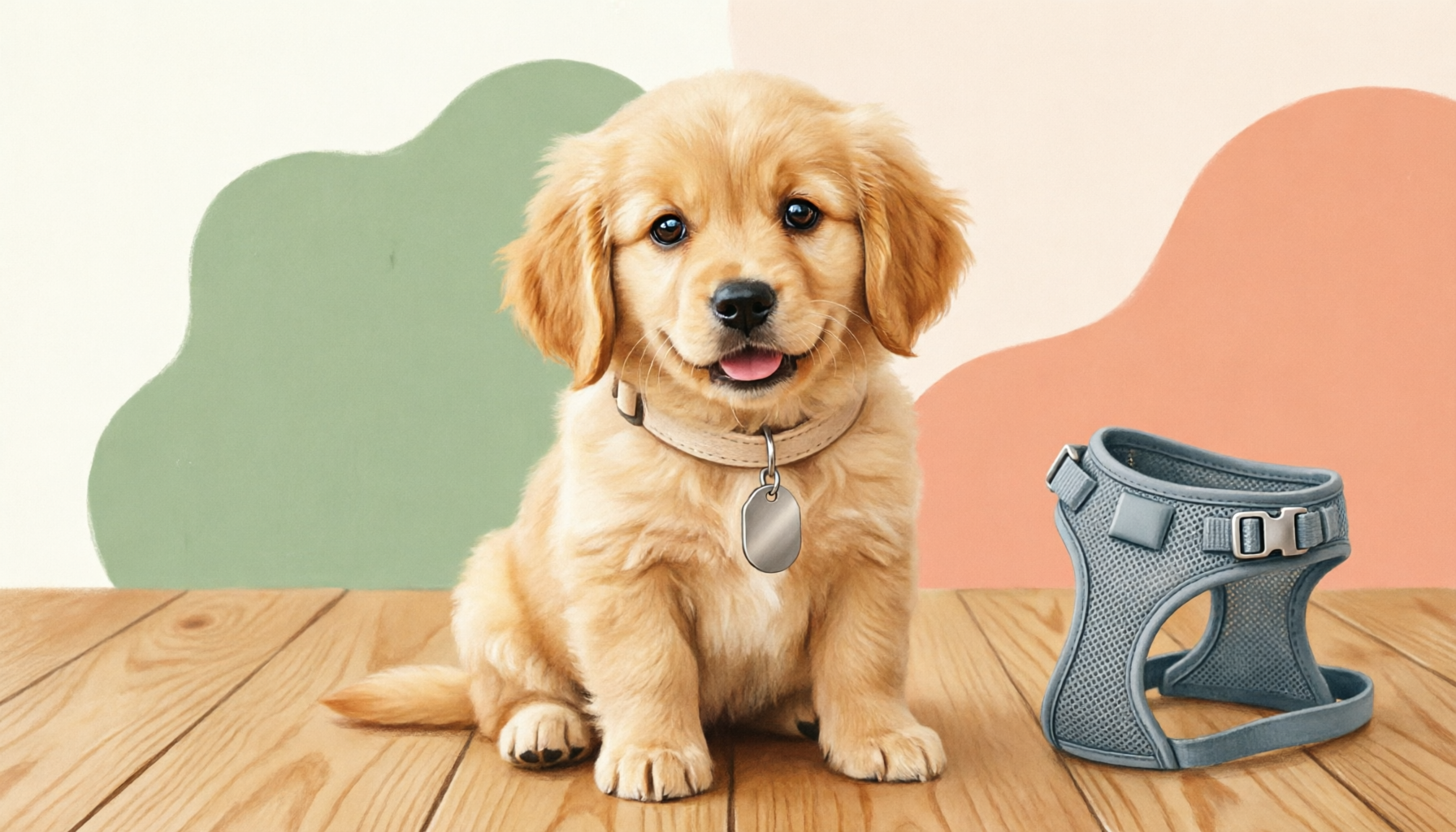
Quick answer: Use a harness for lead training and walks to protect your puppy's developing neck and trachea. Use a collar for identification and short periods at home. Most UK puppies do best with both — a lightweight collar bearing your contact details for everyday home use, and a well-fitted harness for walks and outdoor training.
The Short Answer
There's no single right answer to the collar vs. harness question for puppies — because the answer depends on what you're doing.
- For lead walking and training: a harness is the better choice for most puppies
- For identification at home or in the garden: a collar with your details is essential
- For full freedom off-lead: neither is strictly necessary
The approach most experienced UK puppy owners settle on is: both. A lightweight collar for everyday home use (carrying your contact details to satisfy UK law), and a well-fitted harness for structured walks and lead training.
When to Use a Collar
A collar has one irreplaceable role: carrying your dog's identification. Under the Control of Dogs Order 1992, every dog in a public place in the UK must wear a collar with the owner's name and address. A collar with an ID tag — or a personalised collar carrying that information — is the simplest way to satisfy this requirement.
For puppies specifically, collars are useful for:
Everyday home wear: A lightweight puppy collar worn at home means your puppy is always identifiable if they slip out the door or get found by a neighbour. You don't need to remember to put it on every time.
Quick trips outside: If you're popping into the garden or letting your puppy out for a minute, the collar alone is fine — you don't need to put on the full harness.
Establishing acceptance: Getting your puppy comfortable with wearing a collar from a young age (8 weeks onwards is fine) means it's a normal part of their life rather than something strange introduced later.
The key thing with puppy collars: they must be very lightweight. A puppy's neck is still developing, and even a moderate pull on a heavy adult collar can cause discomfort. A thin, soft puppy collar is all you need — the ID function is what matters here.
When to Use a Harness
For structured walks and lead training, a harness is generally the better choice for puppies. Here's why.
Protecting the trachea and neck: A puppy's neck structure is still developing, and pulling on a collar transfers force directly through the trachea. Even light pulling can cause soft tissue damage over time. A harness distributes force across the chest and shoulders, which is much safer for a developing dog.
Better control during training: A harness gives you more control over a puppy's body position, which matters when you're teaching lead manners. Pulling on a collar tends to encourage pulling — the dog leans into the pressure. A front-clip harness (where the lead attachment is at the chest, not the back) actively discourages pulling without causing neck strain.
Reducing escape risk: Puppies can slip out of collars surprisingly easily — the classic backwards shimmy is something many owners know well. A well-fitted harness is much harder to escape from, which matters enormously during the early weeks of lead training.
For specific puppy situations, a harness is especially useful if:
- Your puppy is a breed with a narrow, deep chest (like a Greyhound or Saluki)
- Your puppy pulls strongly on the lead
- Your puppy is nervous or sensitive and tends to startle when startled
- You're using a long line or extending lead for recall training
The Ideal Setup — Collar and Harness Together
Most UK puppy owners who've done their research settle on using both simultaneously — the collar as ID, the harness for walks.
This means:
- Your puppy wears a lightweight collar at all times at home, with your contact details on it
- When you go for a walk, you clip the lead onto the harness rather than the collar
- The collar stays on throughout, satisfying the legal ID requirement without bearing any pulling force
This isn't complicated or awkward — most puppies adapt to this routine quickly, especially if you've built positive collar and harness associations from an early age.
The key question many new owners ask: "Can I leave the harness on all day?" In most cases, the answer is no — harnesses can rub and create pressure points if worn for extended periods, particularly when the dog is lying down or eating. They're designed for active use, not all-day wear.
Choosing the Right First Collar
Not all collars are suitable for puppies. Here's what to look for.
Weight: Puppy collars should be lightweight — thin webbing, small hardware. A collar that's heavy on a small puppy's neck is uncomfortable and can cause tension injuries. High-quality leather softens without weakening and is an excellent choice.
Buckle type: Always choose a quick-release (snap) buckle. This allows fast removal if the collar gets caught on something. Standard buckles that require two hands to open are not suitable for puppies.
Material: Soft nylon webbing or fabric collars work well for first collars. Leather is fine but tends to be heavier initially. Avoid chain slip collars for puppies entirely.
Width by puppy size:
- XS (Chihuahuas, small Yorkies): 1–1.5 cm
- Small (Cavaliers, medium Terriers): 1.5–2 cm
- Medium (Spaniels, small Labradors): 2–2.5 cm
How to Introduce a Collar to Your Puppy
The first introduction should be calm and positive. Here's how to do it right.
Step 1: Choose the right time. Don't put the collar on when your puppy is tired, hungry, or already anxious. You want them in a calm, curious state.
Step 2: Let them investigate. Show your puppy the collar, let them sniff it. Reward any interest with a small treat.
Step 3: Drape it briefly. Without doing up the collar, drape it around your puppy's neck and immediately give a treat. Repeat this a few times.
Step 4: Fasten for short periods. Do up the collar and let your puppy wear it for five minutes while you play and give treats. Check it doesn't twist or bunch.
Step 5: Remove and reward. Take the collar off and give another treat. The removal shouldn't signal the end of something good.
The minimum age to start: 8 weeks is fine. Most puppies take to a collar without any problem at this age. If you're unsure, your vet can advise — but for the vast majority of puppies, collar introduction at 8–10 weeks works well.
Step 5: Remove and reward. Take the collar off and give another treat. The removal shouldn't signal the end of something good.
The introduction timeline:
- Days 1–2: Let the puppy investigate the collar near their bed or food bowl. No pressure.
- Days 3–4: Put the collar on for short supervised periods indoors. Treat while it's on.
- Days 5+: Extend collar-wearing time. Begin short outdoor sessions in a safe space. Never leave unsupervised.
Minimum age to start: 8 weeks is fine for most puppies. If you're unsure, your vet can advise.
Puppy Collar Safety Checklist
Quick-release buckle: Essential — allows rapid removal if the collar gets caught.
Correct sizing: Too tight causes discomfort; too loose risks the puppy slipping out. Check with two fingers.
Regular checks: Measure every 2–4 weeks. Puppies grow fast.
Supervise when wearing: Never leave a puppy unsupervised with a collar on.
Remove during crate time: Collars can catch on crate bars.
Check for wear: Puppy collars get a lot of use — check stitching and hardware weekly.
How to Introduce a Harness to Your Puppy
Step 1: Let your puppy investigate the harness — same as with the collar. Leave it on the floor, let them sniff it, reward any interest.
Step 2: Introduce each part separately. If your harness has multiple straps (chest, belly, back), let your puppy get used to each one touching them before you put it together.
Step 3: Fit without clipping the lead. Put the harness on and let your puppy walk around in it for a few minutes, treating throughout.
Step 4: Attach the lead indoors first. Once your puppy is comfortable in the harness, clip on the lead and let them drag it around the house. No tension — just the novelty of having it on.
Step 5: Move to the garden or a quiet outdoor space. Only take the harness outside when your puppy is calm and comfortable wearing it indoors.
A note on harnesses that claim to be "no-pull": Front-clip harnesses (where the lead attaches at the chest, between the front legs) genuinely do reduce pulling force and teach better posture. Back-clip harnesses (lead attaches at the top of the back) don't reduce pulling and can sometimes encourage it. If you're choosing a harness specifically to manage pulling, look for a front-clip design.
Puppy-Specific Guidance by Breed
Different puppy breeds have different needs when it comes to collar and harness choices.
Small breed puppies (Chihuahua, Yorkie, Pug): A lightweight collar is especially important — small dogs can be injured more easily by collar pressure. Use an appropriately sized puppy collar rather than an adult collar. A front-clip harness with a chest pad is ideal for walking.
Large breed puppies (Labrador, German Shepherd, Golden Retriever): Harnesses are strongly recommended for lead walking — large breed puppies are powerful enough to cause real neck damage if they pull on a collar. Front-clip harnesses work well for these breeds during the training period.
Brachycephalic breeds (French Bulldog, Bulldog, Pug): These breeds have compromised respiratory systems and are particularly vulnerable to collar pressure. A harness is strongly preferred, and a front-clip design is the best option for these dogs.
Sighthound breeds (Greyhound, Saluki, Whippet): These breeds have deep, narrow chests and long necks. Standard collar sizing doesn't fit them well, and a properly fitted sighthound collar or a breed-specific harness is a better choice.
Common Mistakes to Avoid
Using an adult-sized collar on a growing puppy. The collar must fit the puppy's current size. Check the fit every couple of weeks and replace as your puppy grows.
Leaving a collar on during unsupervised play. Puppies playing together can catch their teeth or claws in another dog's collar, causing injury. Remove the collar if your puppy is playing with other dogs without your direct supervision.
Using a harness that's too loose. A loose harness can shift and rub, causing skin irritation. You should be able to fit two fingers under any strap, but not more.
Pulling on the collar during walks. If your puppy pulls, switch to a harness — pulling on a collar teaches pulling and risks neck injury. A front-clip harness or professional training is the solution.
Not introducing the harness or collar before you need them. Get your puppy comfortable with both items before you need them for a real walk or a vet visit. The first trip in a new collar or harness shouldn't be a stressful one.
Frequently Asked Questions
At what age should a puppy start wearing a collar?
From 8 weeks onwards is a good starting point. Most puppies adapt easily at this age. Start with short periods of wear at home and build up gradually. The collar should be lightweight and properly fitted — an adult collar won't do.
Should my puppy wear a collar or a harness during walks?
A harness is generally better for walks, particularly during the first year when your puppy is still growing and developing. Use the harness as the lead attachment point, and keep a lightweight collar on for identification purposes.
Can a collar damage my puppy's neck?
Yes — pulling on a collar can cause tracheal irritation, cervical spine pressure, and soft tissue damage over time. This risk is higher in puppies than adult dogs because their neck structures are still developing. A properly fitted harness eliminates this risk during walks.
My puppy slips out of their collar — what should I do?
This is very common, particularly with narrow-headed breeds like sighthounds. Solutions include:
- A harness as the primary walking equipment (harder to slip out of)
- A martingale collar (adjusts without a buckle, tighter on pull — but still not recommended for pulling dogs)
- Checking that the collar is actually the right size (not too big)
Should I leave my puppy's collar on all day?
A lightweight collar worn at home is fine — it means your puppy is always identifiable. However, remove it during unsupervised play with other dogs, and check it regularly for fit as your puppy grows. A collar that's too tight or that rubs is worse than no collar at home.
My vet recommended a collar instead of a harness — which is right?
In some specific situations — particular breeds, certain medical conditions, post-surgical care — your vet may have a specific recommendation. Follow their advice in those situations. For most puppies without specific health concerns, using both a collar (for ID) and a harness (for walks) is the most sensible approach.
How do I know if the harness fits properly?
The two-finger rule applies: you should be able to slip two fingers under any strap of the harness. Check the chest strap (the one across the widest part of the ribcage) and the belly strap. Watch for any signs of the harness shifting to one side or rubbing fur away. After the first few wears, check for any redness or hair loss in the areas covered by the straps.
Visa&Momo's handmade puppy collars → are designed for the youngest dogs — lightweight, comfortable, and built to last from the first week home.