
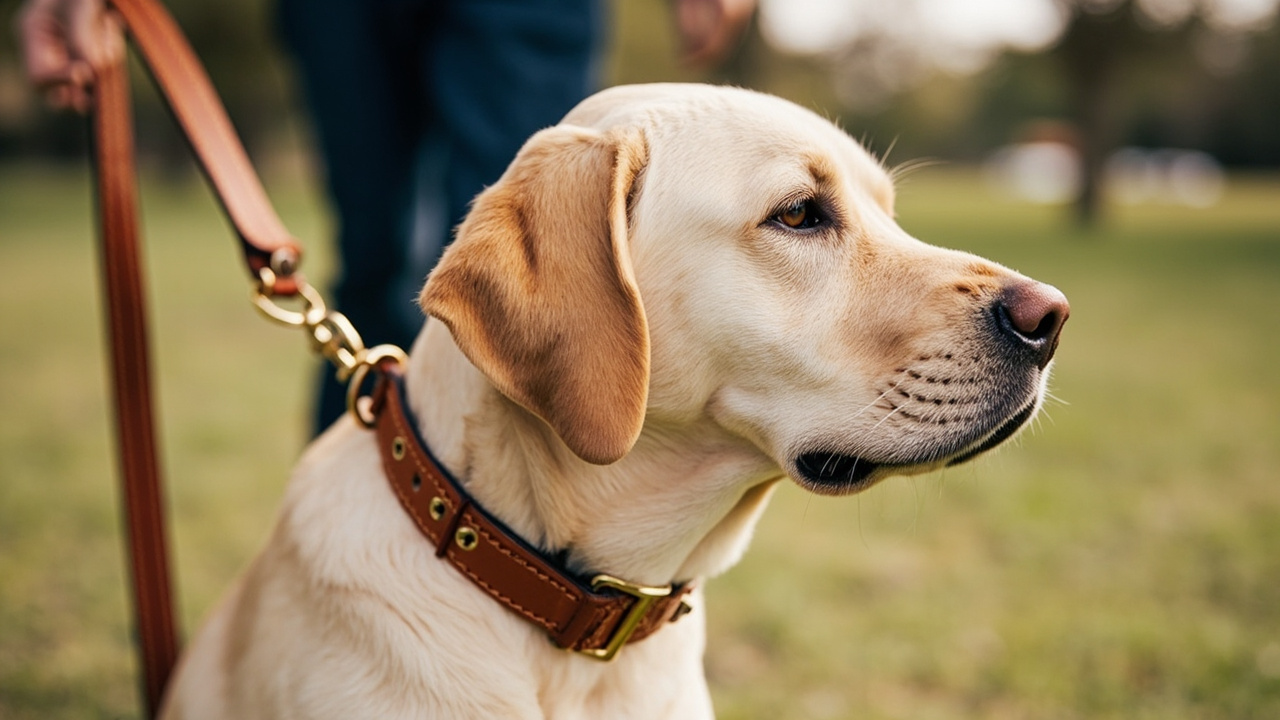
Quick answer: Labradors are large, strong and enthusiastic pullers (typically 25–36 kg, 45–60 cm neck). Choose a wide 25–38 mm collar in sturdy leather or Biothane, fitted so two fingers sit underneath, and prioritise hardware that won't fail under a lunging load. For daily walks on a puller, a front-clip harness is a better choice than a flat collar — keep the collar for ID.
Pulling is a Labrador default
The Labrador Retriever has been the UK's most popular breed for decades. They're affectionate, food-motivated, biddable and tough enough for a long walk in any weather. They're also, by a distance, the breed most likely to pull your shoulder out of its socket before their first birthday.
Labradors were bred to retrieve shot game all day in cold water. That drive hasn't been bred out. Most pet Labs will happily chase a squirrel, a ball or an interesting leaf at full speed. A flat collar on a lunging 30 kg Lab puts the full force of that lunge on the throat, and the rest of it on your arm. Most Lab owners have, at some point, been hauled across a pavement by an adolescent who has just spotted a pigeon.
The other Labs-only problem is the tail. We've watched a 30 kg Lab clear a kitchen counter with one tail-whip. If your phone or laptop is on the side, the collar will probably be on the floor within the hour. It's not a behaviour problem. It's just a Lab being a Lab.
A Lab collar that can't take a lunge load is a false economy. The hardware, the stitching, the material — all of it needs to be rated for a 30 kg dog pulling at speed.
What width your Lab actually needs
Labrador collar width comes up more than almost any other question for the breed. The answer depends on the dog in front of you, but a few rules of thumb help.
- 25 mm (1 inch): fine for a young puppy or a small female, but on a full-size adult it concentrates pressure on a narrow strip.
- 38 mm (1.5 inch): the default for most adult Labs. Wide enough to spread pressure, narrow enough to sit cleanly on the neck.
- 50 mm (2 inch): only useful for very large males or working Labs. On most dogs it bunches at the throat and is harder to adjust precisely.
A 38 mm collar is the sweet spot for the breed. If you have a small female, drop to 25 mm and add a harness for walks. If you have a 36 kg working male, the 50 mm is reasonable for walk-time but heavy for all-day ID wear.
Martingale vs flat for pullers
A martingale (limited-slip) collar is worth considering for any Lab who pulls hard or has a slightly tapered head. A flat collar relies on being tight enough not to slip over the ears; on a Lab who lunges downward, that margin disappears fast.
A martingale tightens just enough when the dog pulls to prevent escape, then releases the moment the lead is slack. For a known puller, the safety margin is meaningful. Most Lab owners we talk to end up on a flat collar for ID and a martingale or front-clip harness for walks.
A well-fitted flat collar (sized so it cannot slip over the head) is fine for most calm adult Labs. Martingales are an extra layer of safety for the lunge-prone ones, and a sensible default for any Lab under 18 months.
What we don't recommend: choke chains or prong collars. They work by causing the dog pain, and a Lab's enthusiasm will outlast the pain within a few sessions. They also damage the throat and coat.
The double-coat trap
The Labrador's thick double coat is what makes the breed water-resistant and cold-tolerant. It also makes accurate collar sizing harder than for short-coated breeds.
A Lab's coat can hide a poorly fitted collar. Part the fur with your fingers and measure closer to the skin, then add 1–2 cm to account for coat thickness. Check the fit by feel, not by eye: two fingers should sit comfortably between the collar and the skin, with no pinching at the edges.
A Lab's neck sheds constantly. The collar collects that shed undercoat, holds it against the skin, and creates the kind of damp, warm environment that hot spots love. Wipe the collar and the neck coat dry after every wet walk, and brush through the neck area weekly with a slicker or undercoat rake.
A Lab who develops a hot spot under the collar is usually a Lab whose collar got left on through a wet walk. It's an easy mistake to make and an easy one to avoid.
Sizing from puppy to adult
A Lab puppy grows fast. Between 8 weeks and 12 months, you'll go through two or three collar sizes. The cheap-and-cheerful supermarket collar is honestly fine for the first three months. By six months it's already too small and probably too light, and that's where the sizing decisions get real.
A rough guide by life stage:
- Labrador puppy (8 weeks to 6 months): 30–45 cm neck. Expect to size up every 6–8 weeks.
- Young adult (6–12 months): 40–50 cm.
- Adult female (25–32 kg): 45–55 cm.
- Adult male (30–36 kg): 50–60 cm.
English-type Labs (blockier, heavier) tend to sit at the heavier end of each band. American-type Labs (taller, slimmer) usually run lighter. Both are valid Labradors; the collar just needs to match the dog.
An adjustable collar covers most of this. For a Lab puppy in particular, a collar with a wide adjustment range saves replacing the collar every two months.
Frequently Asked Questions
What size collar does a Labrador need?
Measure your individual dog. Adult female Labs typically need 45–55 cm; adult males 50–60 cm. Puppies grow fast and go through several sizes in their first 12 months.
What width collar is best for a Labrador?
38 mm (1.5 inches) is the most common choice for an adult Lab. 25 mm works for puppies or very small females; 50 mm is suitable for very large males but can feel bulky.
Is a harness better than a collar for a Labrador?
For daily walks, yes — particularly for a Lab who pulls. A front-clip harness distributes force across the chest and is more comfortable than a flat collar for a strong puller. The collar is still required for ID under UK law.
Can a Labrador wear a collar all day?
Yes — a well-fitted, comfortable collar can be worn all day for ID. Remove it during unsupervised play with other dogs (teeth can catch in collars) and during bathing.
Should I use a martingale collar for my Labrador?
A martingale is worth considering if your Lab slips a flat collar when lunging. For most Labs, a well-fitted flat collar is fine. Avoid choke chains and prong collars.
Do Labradors need a waterproof collar?
It's a strong recommendation rather than a requirement. Labs love water and a waterproof Biothane collar is much easier to live with than a collar that soaks up river water and holds smells.
Visa&Momo's handmade Labrador collars → are available in wide 38 mm leather and Biothane options, with solid brass hardware built for a strong, enthusiastic puller.